The Art of Circle Formation: Building Learning Communities
Product
In online education, one of the greatest challenges is recreating those magical moments where you meet someone who shares your interests and schedule, who has the same level of commitment as you, and with whom you can form a genuine learning connection. While these encounters happen naturally in traditional classrooms, they're much harder to achieve in the digital world.
How do you bring the right people together at the right time? This is a problem that has obsessed us at Circles from the beginning. The solution we found is surprisingly simple, yet remarkably effective.
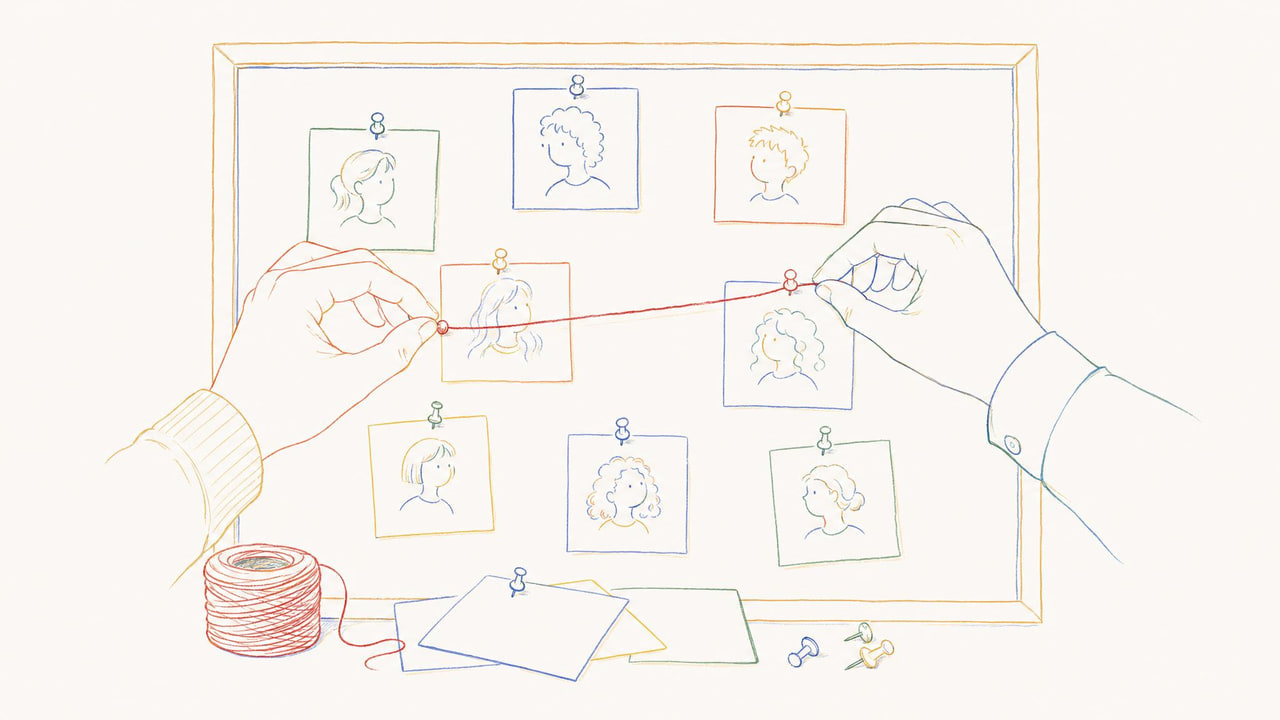
Instead of trying to create a complex algorithm to match people (like dating apps do), we decided to give power to the students. We created a "lobby" for each course where people can connect organically, similar to how they would in a physical classroom.
In this space, you have two options: you can be a host and create your own circle, or you can join an existing one. It's like organizing a study group in university: some take the initiative to create the group, others join when they find one that works for them.
At the end of the day, what makes this system work is something deeply human: our natural capacity to form meaningful connections when given the right space and tools.
Each person in Circles has a profile that goes beyond a simple name and photo. We share our interests, a brief biography, and most importantly: our time availability and location. Do you prefer face-to-face or online meetings? Are you more productive in the mornings or afternoons? This information is crucial for forming groups that truly work.
One of our most interesting discoveries is that this system works better in large courses. It's counterintuitive: one would think that more people would make it more chaotic. But it turns out that the larger the group, the more likely you are to find that perfect match.
Think about it this way: multiple factors need to align: compatible schedules, similar levels of prior knowledge, preferences about meeting format (in-person or online), and even learning styles. With more people in the lobby, the probabilities of finding your learning "tribe" increase significantly.

What makes our system unique is its flexibility. Unlike other platforms that force all groups to meet at the same time (like Zoom breakout rooms), in Circles each group chooses its own schedule. Some meet Monday mornings, others Saturday afternoons. Some prefer to meet in a coffee shop, others from the comfort of their home.
**This freedom of choice is fundamental. When people have the power to choose when and how to meet, commitment emerges naturally. **The group holds together on a mutual agreement between people with similar goals, and nobody imposed it on them.
At the end of the day, what makes this system work is something deeply human: our natural capacity to form meaningful connections when given the right space and tools.
Circles are limited to five people for a reason: it's the perfect size for everyone to have a voice, for trust to develop, and for coordination not to become a headache. It's small enough to be intimate, but large enough to generate enriching discussions.
The most fascinating thing is seeing how these groups evolve. What begins as a simple matching of schedules often becomes a lasting learning community. We've seen circles that continue meeting even after the course ends, and others that have evolved into valuable professional networks.
At Circles we started from a logistical problem, how to bring people together to study, and ended up somewhere else: building the environment where authentic connections around learning can emerge. And that, we believe, is the true magic of education.
Featured courses
Bring this topic to your team with a Circles course.
Agency and concept-based learning
Explore the foundations of IB, the student profile, student agency, and concept-based learning to transform your teaching practice.
View course →Agency: Helping Students Take the Lead
Practical strategies to create classroom environments where students feel empowered and take ownership of their learning journey.
View course →AI Builder Bootcamp for Educators
Build AI-powered educational tools using no-code and low-code platforms, creating functional apps from ideation to implementation.
View course →