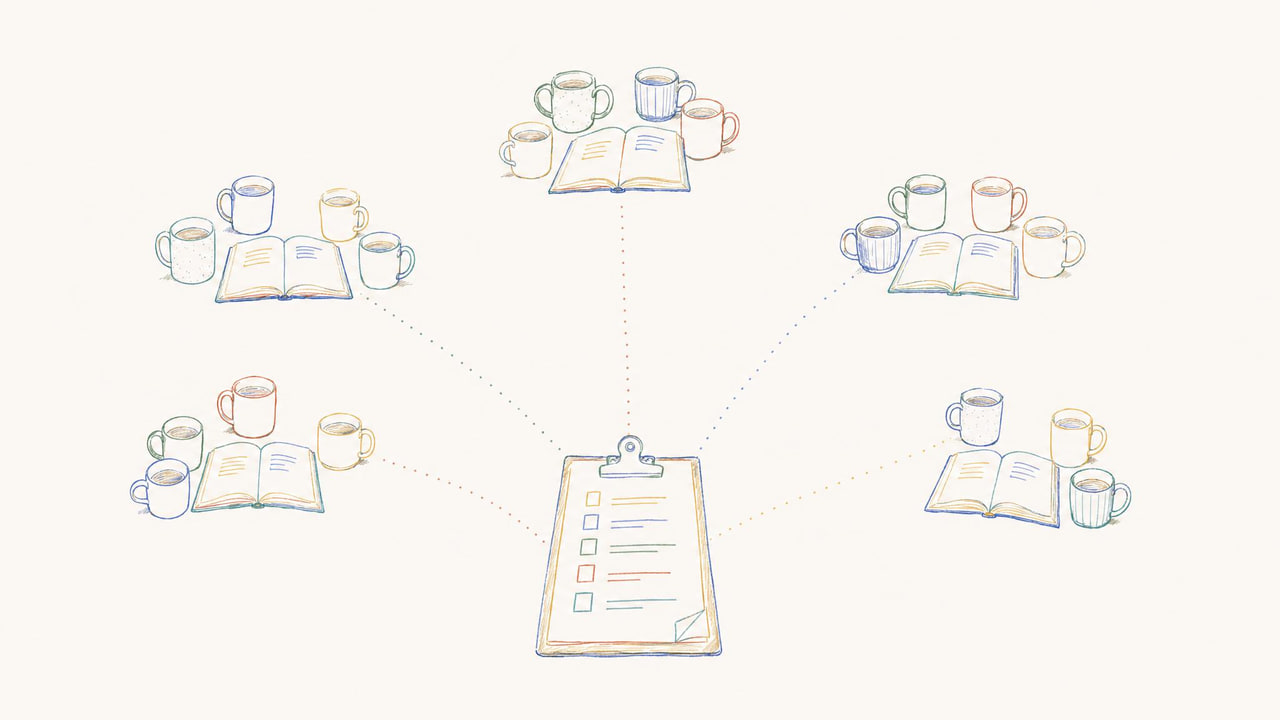
Professional learning communities and how to sustain them
Analysis
Most school leaders have heard that teacher collaboration improves teaching, and the research backs them up. Professional learning communities (PLCs) are small groups of teachers who meet regularly to work on problems from their own classrooms. They improve what happens in lessons and, on more modest evidence, what students learn.
The trouble starts when a school tries to keep them running. PLCs tend to break down on operations, because schedules are hard to line up, every session needs facilitating, and leaders struggle to tell whether any of it is working. This article argues for splitting the decisions. Teachers choose who they learn with and when they meet, the institution sets the focus and watches progress, and the structure of each session does much of the work that now falls on a facilitator.
A note on names. In Chile, where much of our work happens, the Ministry of Education's teacher development centre (CPEIP) calls them comunidades de aprendizaje profesional. The idea is the same as a PLC, with teachers improving their practice together.
What the evidence shows
Richard DuFour (2004), one of the people who did most to spread the model, described the collaboration at the heart of a PLC as a systematic process in which teachers work together to analyze and improve their classroom practice. The CPEIP definition is just as concrete. Teachers meet regularly to work on problems from their classroom practice and agree on changes they then carry into their classrooms.
The results are favourable, with caveats.
- Teaching practice. In the review by Vescio, Ross and Adams (2006), all ten studies analyzed support the idea that taking part in a learning community changes how teachers teach.
- Students. In the same review, all six studies that measured achievement found that student learning improved. One of them, by Berry and colleagues (2005), followed a rural elementary school for four years as it went from just over half its students at grade level to more than 80%. It is a single case with no comparison group. The meta-analysis by Lomos, Hofman and Bosker (2011) finds a small but significant effect (d = .25).
- Teachers and students together. Drawing on more than 9,000 teachers in 336 Miami-Dade schools, Ronfeldt and colleagues (2015) found that where collaboration is of higher quality, students make bigger gains in math and reading, and teachers themselves improve faster.
- Teacher satisfaction. Using TALIS 2018 data, the OECD links professional collaboration with higher job satisfaction and teacher self-efficacy.
At Circles we think that last point weighs as much as the others, because it is easier to commit to learning when you do it with colleagues. We wrote about motivation in what a bike ride teaches us about motivation.
Why they are hard to sustain
Policy often asks for collaboration. Chile's Law 20.903 promotes collaborative work aimed at building learning communities and raised the share of teachers' contracted time set aside from teaching. Even so, the Ministry's analysis of TALIS 2024 concludes that the country shows gaps in opportunities for collaborative learning. In the twelve months before the survey, 79% of teachers attended courses or workshops and 46% took part in teacher networks. Across the OECD, TALIS 2018 found that only 9% of teachers observe a colleague's class and give feedback at least once a month. Three problems help explain the gap.
Coordination is hard. A community only works if several people can meet every week or every month. Citing UNDP research, the Chilean Ministry reports that 36% of teachers in public and state-subsidized schools say their teaching hours are not kept as their contracts set out. In three Chilean schools studied by Peña Ruz and Armengol (2024), structural conditions such as time and schedules scored lowest of all.
Leaders see very little. CPEIP's guide suggests that school leaders monitor each community's progress, for example through regular meetings with each group's facilitators or by observing some sessions. With five communities, that means five extra meetings or five sessions to sit in on. And even inside the groups, practice tends to stay at the level of anecdote. In five Chilean schools, Peña Ruz (2023) found teachers shared stories about experiences that had "worked well" more than they observed one another.
Managing them takes energy. CPEIP recommends one or two facilitators per community to make sure people show up, pass on information, mediate discussion and structure sessions. In the schools Peña Ruz and Armengol studied, administrative load already squeezes the time for that work. When facilitation slips, the conversation can thin out. In recorded meetings across four US districts, Andrews-Larson, Wilson and Larbi-Cherif (2017) documented a session without a protocol in which all 38 of the facilitator's questions were about pacing, coverage and logistics.
A fourth risk appears when leadership tries to fix the other three by mandate. Andy Hargreaves and Ruth Dawe (1990) called top-down collaboration "contrived collegiality". Hargreaves and Michael O'Connor warn that it can backfire, leaving teachers collaborating even less than before while they go through the motions.
What a PLC needs to grow
If the problem is operational, so is the answer. To multiply across a school or a network of schools, a community needs four conditions.
- Teachers choose who and when. Here we part ways with CPEIP's guide, which leaves forming the groups to school leaders, even though it also recommends that participation be voluntary. We suggest separating the two decisions. Leaders set the focus and teachers form their group. It is a direct defence against contrived collegiality, and it supports the trust that Hallam and colleagues (2015) identify as critical. Groups can stay within one school or mix schools. In the Netherlands, Prenger and colleagues (2018) found moderately positive effects across 23 communities of teachers from different schools.
- The institution sets the focus. DuFour puts student learning at the centre, and CPEIP proposes linking the communities to the school improvement plan. Choosing the topic is the leadership's job and choosing the meeting time is the group's. A topic chosen by leadership can feel like a mandate too, which is why the who and the when stay with teachers.
- Structure does part of the facilitator's work. DuFour warned that some teams mistake collaboration for congeniality, and Hargreaves and O'Connor call for protocols and expertise as well as trust. In the Andrews-Larson study, using a tool to structure the activity went with better questions from the facilitator. Our reading is that affinity keeps people showing up and structure keeps them learning. A session with set activities and feedback from someone with expertise can hold quality steady without a trained facilitator in every group.
- Progress is visible without watching the conversation. Leaders need to know who takes part and what each group produces. To protect trust, what is said in the session stays with the group.
What we don't know
The evidence on students is thinner than the evidence on teachers. Vescio and colleagues acknowledge that the impact rests mostly on teachers' own perceptions, with limited evidence beyond them. Ronfeldt measures an association, without proving cause. Almost all the evidence comes from the United States and Europe, and the Chilean studies available describe conditions and perceptions without measuring learning outcomes. Nor are there studies comparing groups of two to five with the groups of five to ten that CPEIP recommends.
What to try next week
- Before you form any groups, ask your teachers which two colleagues they would like to learn with this semester.
- Pick a single focus from your school improvement plan and frame it as the question the community will work on.
- In the first session, have the group analyze an outside example, such as a video or a case, before looking at their own lessons. CPEIP suggests this to build trust.
- Check whether non-teaching time is grouped into blocks where a team can actually meet.
- Choose two signs of progress you can see without sitting in, such as attendance and one piece of work per session.
How we do it at Circles
Circles was built around this idea. Every circle works as a small professional learning community, and more than 10,000 teachers from more than 500 schools have learned this way. A circle brings together 2 to 5 colleagues, who create one or request to join one. The host accepts requests, and the “My institution only” filter lets teachers learn with people from their own school. In a cohort-paced course, the circle picks its meeting time. In a circle-paced course, the host sets the start date, pace and meeting time from the course's options. At every meeting the group works through a structured session with activities, and afterwards our tutors review its deliverable.
School leaders decide which courses their teachers take, receive weekly participation and progress reports by teacher and by circle, and follow everything in Compass, the institutional tracking dashboard. We handle enrollment and reporting. The details are in how Circles works and the thinking behind it is in why Circles. We wrote separately about learning AI as a team inside these communities.
We want learning with other teachers to be easy to start and easy to keep going, for the love of learning.
Featured courses
Bring this topic to your team with a Circles course.
Agency and concept-based learning
Explore the foundations of IB, the student profile, student agency, and concept-based learning to transform your teaching practice.
View course →Agency: Helping Students Take the Lead
Practical strategies to create classroom environments where students feel empowered and take ownership of their learning journey.
View course →AI Builder Bootcamp for Educators
Build AI-powered educational tools using no-code and low-code platforms, creating functional apps from ideation to implementation.
View course →