AI for education - advanced
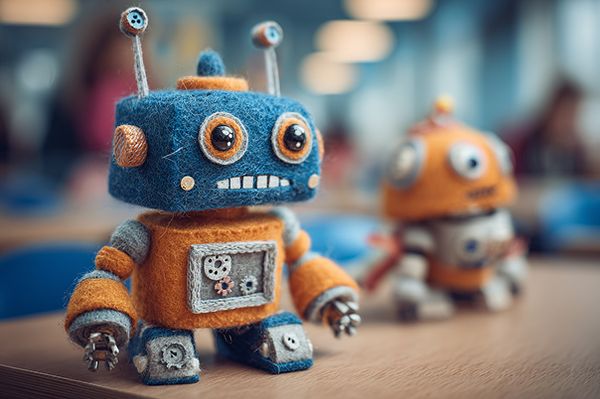
Take the next step: work with AI agents, create reusable workflows, and build your own educational tools.

About the course
This advanced 6-session course is designed for teachers, school leaders, and education assistants who already use AI tools and want to take the next step: working with AI agents and building their own educational tools.
Throughout the course, participants will get to know agents that operate in chatbots and cloud suites, try agents that work directly on their computer, and learn to coordinate teams of agents with defined roles. They will create reusable workflows for their teaching tasks, build their own educational prototype by conversing with an agent, and close by designing a personal agent for their school community.
Each week they will work with their learning circle on hands-on projects they can apply directly in their educational context.
How it works
You will join a group of 2 to 5 colleagues, and as a group, you will meet 6 times, either in person or online, at a time you all agree on.
Join a circle
Organize your study group with colleagues during the match period.
Agree on a schedule
Decide the most convenient time for your sessions, online or in person.
Join and collaborate
When the session arrives, connect with your colleagues and complete the activities together.
What's included
Requirements
- Have completed a basic AI course, such as AI for education
- Interest in exploring AI agents and building your own tools
- Tolerance for frustration (things won't always work the first time)
- Availability to participate in session 0, tutorials, and peer sessions
Course syllabus
Session 1: Agents in chatbots and cloud suites
- • Distinguish chatbot, chatbot with tools, and agent: it plans, uses tools, observes results
- • Try Gemini integrated in Google Drive/Docs and ChatGPT Agent on a real teaching task
- • Observe how much autonomy the AI takes, what permissions it asks for, and what human review is still necessary
Session 2: Agents that work on your computer
- • Move from “AI inside a document” to “AI inside a working environment”
- • Use Antigravity to have an agent read one of your folders, summarize sources, and generate a new document
- • Meet Claude Desktop, Claude Cowork, and Claude Code as references for the near horizon
Session 3: Markdown and agent teams
- • Convert rubrics, lesson plans, and criteria to Markdown — the portable language any agent can read
- • Build your own library of materials without depending on a specific platform
- • Coordinate several agents with roles (curriculum expert, instructional designer, reviewer) that divide up and synthesize a task
Session 4: Reusable skills and workflows
- • Distinguish a workflow (how I repeat a task) from a skill (how I give the agent a new capability)
- • Write a teaching workflow like “grade open-ended answers with a rubric” and apply it to a real case
- • Define what can be automated, what should only be assisted, and what remains a human decision
Session 5: Local vibe coding and educational tools
- • Create your own educational prototype (game, simulator, generator) in HTML/CSS/JavaScript by conversing with the agent
- • Start from the learning goal, the user, and the evidence — the agent writes the code, you decide
- • Leave with a working mini app on your computer, ready to iterate with students
Session 6: Personal agents and the near future
- • Meet OpenClaw and the idea of agents that live in WhatsApp, Telegram, or Slack with memory, tools, and initiative
- • Design an agent for your school community: accessible data, tools, permissions, and limits
- • Close with an agent “constitution” and a concrete deployment plan for your context
Meet the instructor
Sebastián Marambio
Bachelor of Arts from Harvard University, high school mathematics teacher, and former director of the Innovation Center at the Chilean Ministry of Education. He is the founder of Circles and an artificial intelligence instructor.
 LinkedIn
There are only
good questions ;)
Still have questions? Write to us!
Related courses
All courses
AI Builder Bootcamp for Educators
Build AI-powered educational tools using no-code and low-code platforms, creating functional apps from ideation to implementation.


AI for education
Learn to use generative AI to plan lessons, create teaching resources, and assess effectively.

Effective Technology Integration
Learn to design impactful lessons that seamlessly integrate technology to enhance student learning with purposeful digital tools.

Related articles
Visit the blog
AI for teacher development: learning alone or with your team
55% of Chilean teachers already use AI at work, but how they adopt it matters as much as whether they do. The case for embedding AI in existing PLCs, and three steps for school leaders.

Written comments that guide revision
What written feedback can contribute, when it may be useful to concentrate it on one goal, and the limits of the available studies.

Lesson planning with AI: evidence and limits
What one trial shows about using AI to prepare lessons, which decisions remain with the teacher, and how to review a draft before using it.